


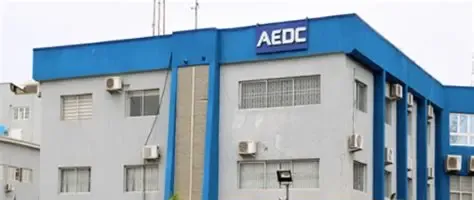


Customers question how electricity payments are being treated after a disputed ₦5,000 transaction was reportedly used to offset an outstanding bill instead of generating a prepaid meter token.
Electricity customers under the Abuja Electricity Distribution Company (AEDC) are raising concerns over transactions that are reportedly marked successful without delivering the prepaid electricity tokens they paid for.
The complaints have sparked questions about how AEDC processes electricity payments, particularly after a customer shared a dispute resolution record showing that a ₦5,000 recharge was successfully processed but did not generate a token.
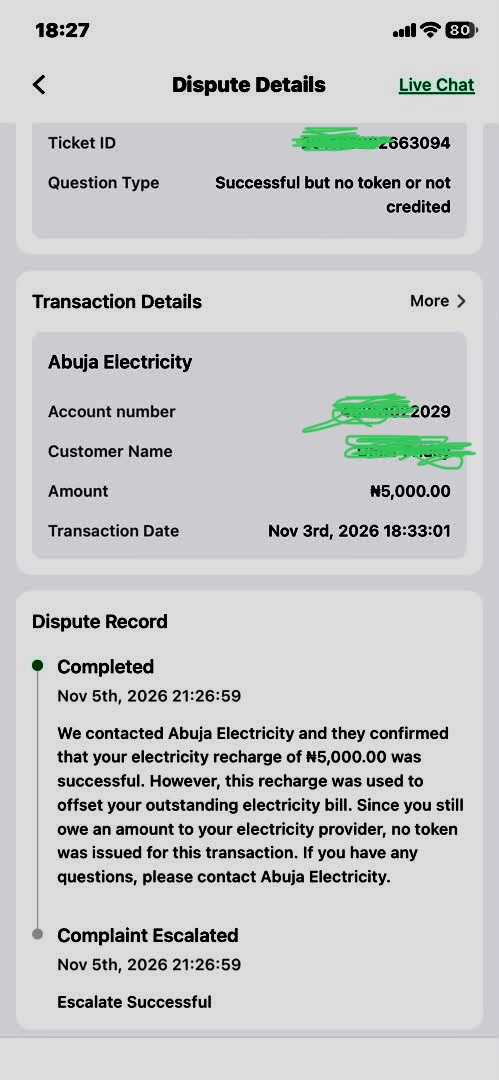
In the screenshot obtained by Bzzyer, the customer had raised a complaint over a transaction made on November 3, 2026, describing the issue as a successful payment for which no token was received.
However, AEDC’s response, recorded on November 5, stated that the company had contacted the electricity distribution provider and confirmed that the ₦5,000 transaction was successful.
The explanation that followed has raised further concerns.
According to the dispute record, the recharge was used to offset the customer’s outstanding electricity bill. Because the customer still owed the electricity provider, no token was issued for the transaction.



The complaint was subsequently marked as completed, with the customer advised to contact Abuja Electricity for further clarification.
For a customer who believed they had paid ₦5,000 to purchase electricity, the explanation raises an important question: how can a payment for a prepaid recharge be completed without the customer receiving the electricity token they expected?
Refund programme raises further questions
The complaints are emerging amid AEDC’s ongoing refund programme for eligible customers who previously paid for prepaid electricity meters under the Meter Asset Provider (MAP) scheme.
AEDC announced the programme in July 2026, explaining that eligible customers would receive refunds as electricity credits rather than cash payments.
Under the arrangement, customers are notified through SMS or email, with refund details and a unique load token that can be entered into their prepaid meters. The company also provides an online portal where customers can check their refund status.
The refund portal is available at https://maprefund.abujaelectricity.com/.
AEDC’s published explanation presents the refund as a credit to the customer’s prepaid meter. However, the dispute involving the ₦5,000 recharge raises questions about how outstanding balances are handled and whether customers are adequately informed when payments are applied to existing debts rather than issued as tokens.
It is important to distinguish between the MAP meter refund programme and an ordinary electricity recharge. The two are not the same transaction, and there is currently no confirmation that the refund programme caused the missing-token complaints.
Nevertheless, the timing and reports of similar experiences online make it important for AEDC to clarify whether any changes to its billing or payment reconciliation processes could be contributing to the problem.
Customers deserve more than a successful transaction notification
A payment confirmation should give customers confidence that they have received the service they paid for, or at the very least, a clear explanation of how their money was applied.
Where a prepaid electricity payment is used to settle an outstanding balance, customers should be informed before or immediately after the transaction, with a transparent breakdown of the amount deducted and any remaining credit.
Without that clarity, customers may continue making payments expecting electricity tokens, only to discover that the money has gone towards a bill they may not have understood or anticipated.
The Nigerian Electricity Regulatory Commission (NERC) recognises consumers’ rights to transparent electricity billing, proper information and the prompt investigation of complaints. It also provides for customers to escalate unresolved complaints to the appropriate NERC Forum Office.
For customers facing similar issues, keeping transaction receipts, payment references and complaint records will be important when seeking a resolution.
AEDC needs to address the complaints
The issue deserves a clear public response from AEDC, particularly if more customers are experiencing successful payment notifications without receiving corresponding electricity tokens.
The company should explain under what circumstances prepaid electricity purchases can be applied to outstanding balances, how customers are notified of such deductions and what steps they can take to challenge balances they believe are incorrect.
It should also clarify whether the recent MAP refund process has any connection to the complaints being raised, rather than leaving customers to draw conclusions from the timing of the two developments.
For electricity consumers already dealing with rising household expenses and unreliable power supply, paying for electricity only to discover that no token will be issued is another frustrating experience.
The bigger concern is not just the missing token. It is whether customers can clearly understand where their money goes after they make a payment.
Bzzyer will continue to follow the complaints and AEDC’s response.