




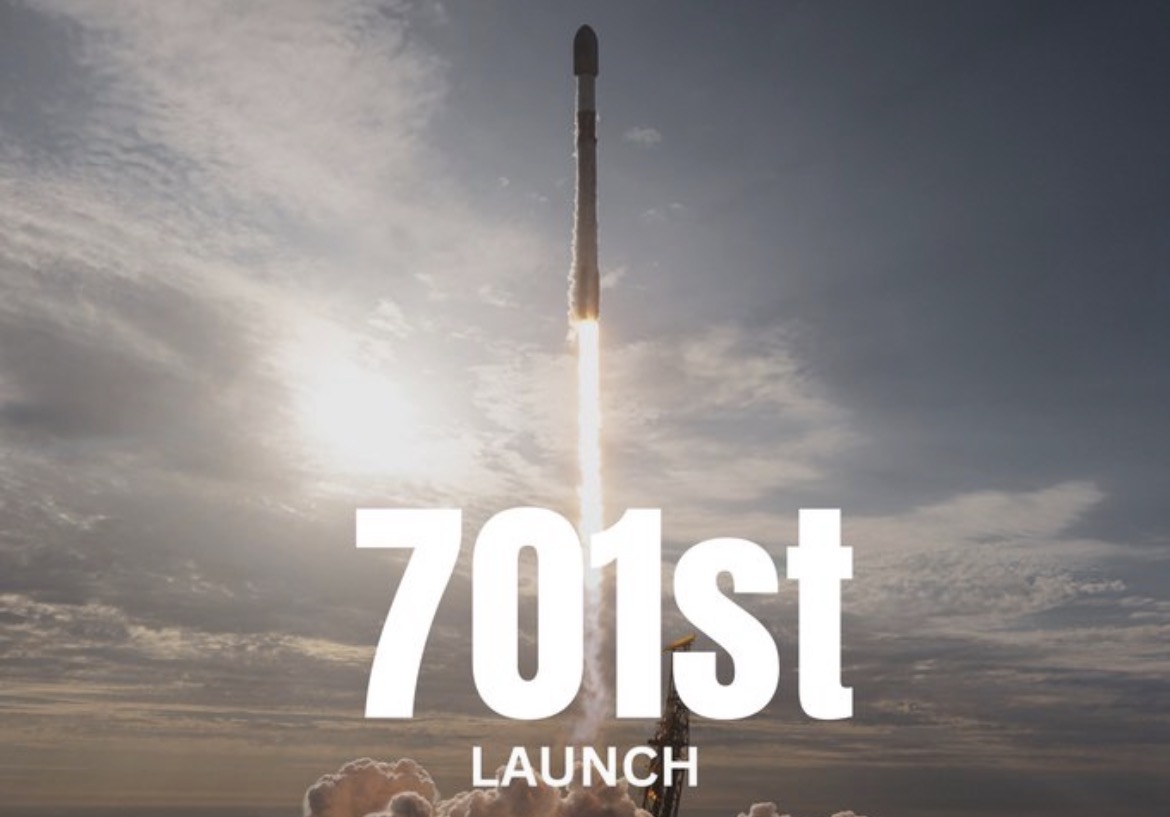

SpaceX’s Falcon 9 rocket has reached a major milestone, completing its 700th launch as the company continues to demonstrate how reusable rocket technology can change the economics and pace of space exploration.
The milestone came during the Starlink 15-18 mission, which lifted off from Vandenberg Space Force Base in California on October 30 local time. The launch carried 27 Starlink satellites into low Earth orbit.
The rocket’s first-stage booster returned safely to Earth about eight and a half minutes after liftoff, landing on SpaceX’s drone ship, Of Course I Still Love You, in the Pacific Ocean.
The flight also demonstrated the extensive reuse of SpaceX hardware. The booster, identified as B1093, completed its 18th mission, showing how the company has turned rocket recovery and reuse into a central part of its launch operations.
From a new rocket in 2010 to hundreds of missions
Falcon 9 first flew in June 2010. Since then, SpaceX has developed it into one of the most frequently used orbital launch vehicles in the world.
Its defining innovation is the ability to recover and reuse the first stage, rather than discard the entire rocket after every mission.
That approach has helped SpaceX increase launch frequency and reduce the need to manufacture a completely new first-stage booster for each flight.


What once required long periods of preparation can now happen within days, as previously flown boosters return to service after inspection and refurbishment.
The result is a launch system that has made rocket recovery a routine part of modern commercial spaceflight.
Starlink drives much of the launch activity
A significant share of Falcon 9’s recent missions has supported Starlink, SpaceX’s satellite internet network.
The October 30 mission added another 27 satellites to the growing constellation. These satellites are designed to provide broadband internet coverage across different parts of the world.
This matters beyond the space industry. Satellite internet has become an increasingly important alternative for communities and businesses where traditional broadband infrastructure remains limited.
For countries such as Nigeria, where connectivity gaps persist between urban centres and underserved communities, developments in satellite internet could create more options for businesses, schools and households.
However, wider access will still depend on affordability, service availability and the cost of connecting users.
The bigger story is the speed of innovation
Falcon 9’s 700-launch milestone is more than a celebration of engineering. It reflects a shift in how the global space industry approaches access to orbit.
SpaceX has shown that rockets do not necessarily have to be single-use vehicles. By recovering and reusing major components, the company has built a launch operation capable of supporting frequent missions.
The next challenge is how far that model can go. SpaceX is increasingly directing attention towards Starship, its larger next-generation rocket, as it pursues even greater launch capacity and reusability.
For now, Falcon 9’s milestone offers a clear picture of how much spaceflight has changed since 2010. Launching a rocket and bringing its booster back for another mission is no longer an extraordinary one-off event. It has become part of the routine.